
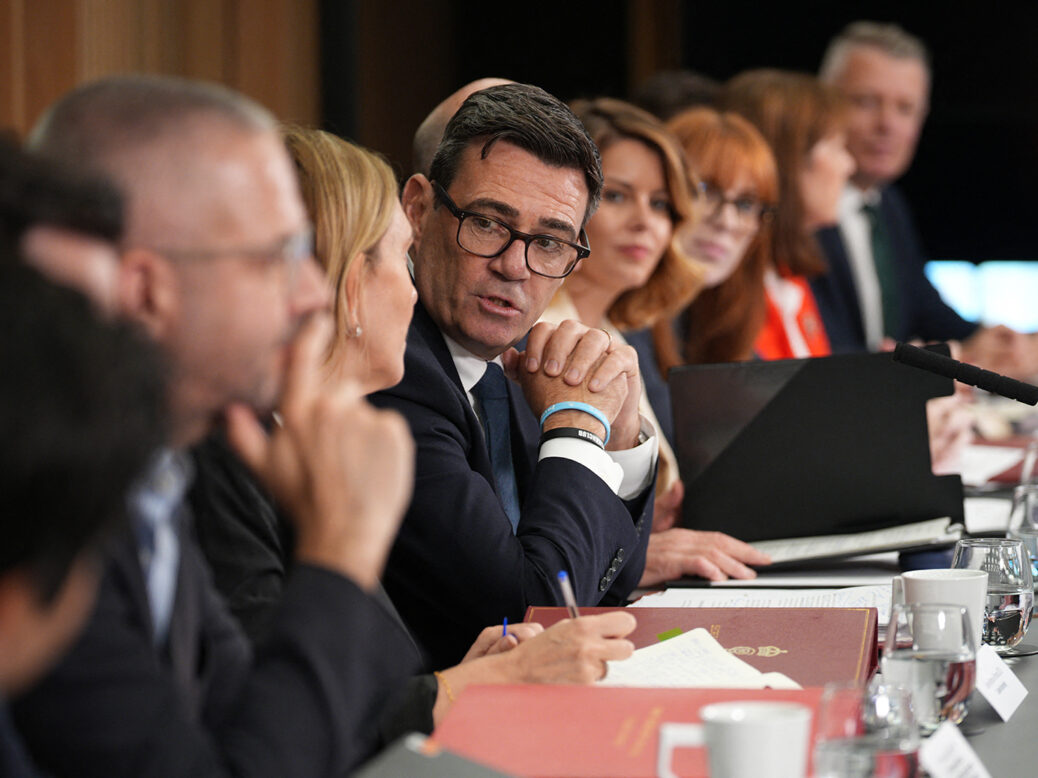
A number of interpretations of Burnhamism can be found on the loose in the wild right now. The take from the right is that he’s an old-style tax-and-spend leftie who’ll lead us to ruin; but since the people pushing this line are defenders of a failed ideology who have neither government’s nor public’s best interests at heart, this we can safely ignore. Another is that it’s just Starmerism with better comms. The retention of Shabana Mahmood at the Home Office, and Bridget Phillipson in the equalities brief, does suggest there’ll be no change of direction on some of the social issues – treating immigrants like human beings; trans rights – that have done so much damage. So. Maybe.
But then again, maybe not – because in other areas, the new regime has made noises suggesting a more significant departure. In Burnham’s sincere enthusiasm for devolution, and his claim he’ll spend his political capital on social care reform – the biggest block to local government that can actually, in any way, govern – there’s a glimpse of a genuine prescription for what’s gone wrong and how to fix it. Actually fixing it is a different matter, of course, but after two years of a Labour prime minister who seemed to think that everything was in some way fine, it brings a tear to the eye to have a leader with any such ambition at all.
There’s another, more immediate departure from Starmerism: the visible determination to have Something To Announce. Week one has brought a flurry of promises, leaving the Today programme scrambling to rethink its agenda in exactly the way July of 2024 did not. VAT cut from electricity bills, bus fares capped, more tax relief aimed at pubs and music venues… None of these are huge measures in themselves, of course, but together they paint a picture of a government actively engaged in trying to make life better. The inevitable vox pops suggest that the great British public – or at least, the bit of it available to chat in a shopping centre of an afternoon – is exactly as grateful for this effort as one would imagine.
The most significant of these early promises was the first, made before the new Prime Minister even passed the threshold of Downing Street. The return of rough sleeping – a very visible crisis in the early 1990s that was, not incidentally, largely eradicated by the last Labour government – is not merely a stain on the nation’s conscience, but a horribly visible symptom of national decline. If the government can end it, it won’t just be the vulnerable people brought back into the warm who’ll benefit. The streets will feel safer; the country more prosperous. And Andy Burnham will have shown that the government can still make things better.

In 1982, the social scientists James Q Wilson and George L Kelling proposed the “broken windows” theory: the notion that visible signs of disorder or neglect can have disproportionate negative effects by giving permission for other anti-social behaviour. More extreme interpretations of the theory, which effectively suggest that fresh double glazing can prevent violent crime, are contested, to say the least. Nonetheless, there’s clearly some truth to the idea that the public’s sense of national prosperity and government capacity is influenced by the state of the world around them.
There are surely other visible signs of decay which have contributed to our sense that Something Has Gone Wrong. The high street that’s gone from a bustling community centre to a miserable alley of vape shops and nail bars. The vague sense of squalor resulting from uncollected litter and inadequate public loos. Rewiring the British state and fixing its creaking public infrastructure would be huge, long-term challenges even if it weren’t for the geopolitical instability and rolling economic crisis. But if the government can only find a way to make town centres more welcoming, and ensure the police come when called – address some of the many, small things which rarely trouble the lobby, but which make it feel like Things Are Getting Worse – it could make the Britain of 2029 feel like a big improvement on that of 2024.
Keir Starmer offered the public a politics that treads more lightly on people’s lives; but that, I think, was a misread. Most people don’t care what happens in Westminster, but they do think it’s the job of government to make their lives more pleasant. They want to see that things can and will get better.
Burnham has made clear he feels bound by the manifesto on which Labour was elected in 2024. But that manifesto had a one-word slogan, printed in bold red type: “Change”. Maybe the new regime can deliver that; maybe it can’t. But at least it feels like it’s trying.
[Further reading: Andy Burnham’s cultural revolution]
Content from our partners


Related

Join the debate
Subscribe here to commentIts good that Burnham is trying but his analysis of what’s gone wrong is wrong, and in any case the expectations he is raising cannot be fulfilled. The two facts of our current woes are high state debt and low productivity. Neither can be blamed on paper tigers like Thatcherism (why persist in blaming a secular movement in world economic history on one woman?) or neo-liberalism (which underpins the real, as opposed to the rhetorical, “Manchesterism”). Rhetoric and comms strategies aside, I suspect that in fact Burnham will turn towards “change” we can believe in, as Starmer did, but with more flair. What is needed is the higher business investment Reeves’s better policies encouraged, with the welfare reforms referenced in today’s papers. Unspectacular, but more likely to unlock productivity and reduce spending. Perhaps the guff about reversing the last 40 years will work in mollifying the Labour left enough to get through the reforms Starmer could not deliver.
It will take more than the repair of broken windows and more efficient cleaning of our streets to generate growth. I accept that it worked in New York and encourages civic pride but an incentive to increase the rate of investment by industry to the average of other G7 countries (currently we invest less than half the rate of the other G7 countries). Incentives are one thing, tax relief and government grants are another. These should never exceed 50% of the tax paid by the individual company in the previous five years. There is talk of abolishing council tax and stamp duty on houses and imposing a land value tax of 1.3% on the value of houses. This is likely to hit the middle classes harder than the current system. A wealth tax on assets over £10 million would avoid increasing tax on the willing and easier to implement.
“visible determination to have Something To Announce” I almost ran out of the room screaming. Doesn’t anyone understand the Thump in the US? Every minute he is determined to announce anything, anything, like a circus ringmaster without a memory. And quickly, guilt by association and an active media make for universal head spinning and anger.
Hopefully Burnham is more substance and commitment, but we just don’t know.